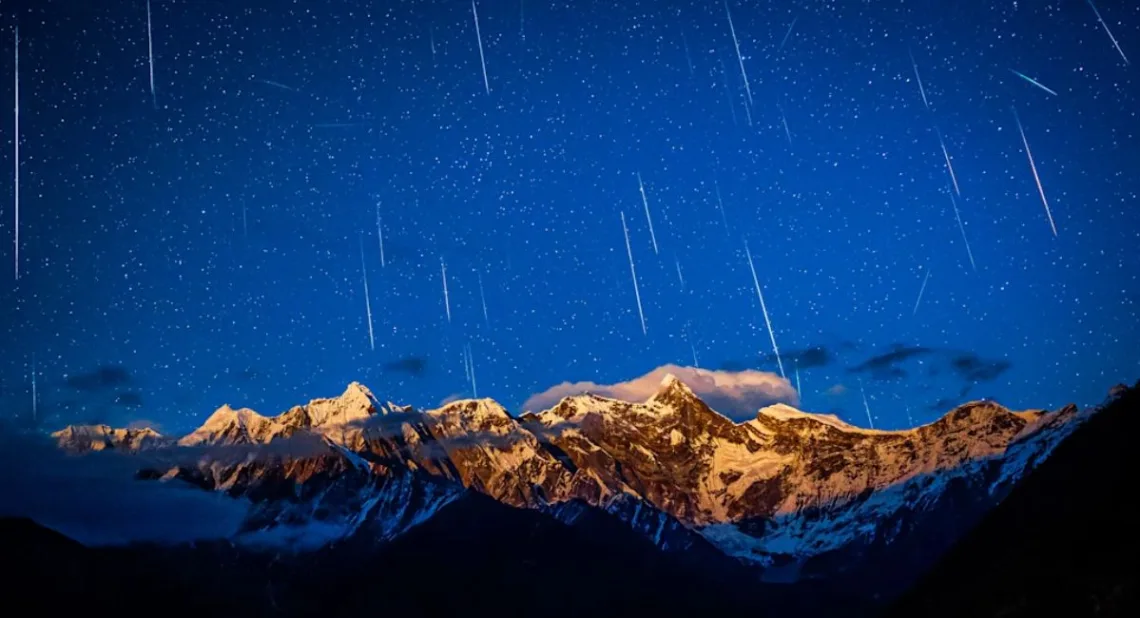
The Geminids meteor shower returns to Australian skies this December, and 2024 brings nearly perfect viewing conditions. Running from December 4-20 with peak activity on the night of December 13-14, this annual celestial event is widely considered the best meteor shower of the year.
What makes the Geminids special? Unlike most meteor showers that originate from icy comets, the Geminids come from an asteroid called 3200 Phaethon. This rocky origin creates brighter, more colorful meteors that flash yellow, green, blue, and red as they streak across the sky. At peak, you can expect to see 50-150 meteors per hour depending on your location and sky darkness.
The best news for 2024? The waning crescent moon won’t rise until after 2:00 AM on December 14, giving you hours of dark sky viewing before moonlight interferes. This is significantly better than 2023 when a fuller moon washed out many fainter meteors.
When to Watch: Peak Times for Every Australian City
The Geminids peak overnight Friday, December 13 into Saturday, December 14, 2024. While meteors will be visible throughout the night, the best viewing window is between 2-4 AM when the radiant point (where meteors appear to come from) is highest in the sky.
Here are the precise peak times for major Australian cities:
Eastern States:
- Brisbane: 3:08 AM AEST
- Sydney: 4:01 AM AEDT
- Melbourne: 4:13 AM AEDT
- Canberra: 4:05 AM AEDT
- Hobart: 4:30 AM AEDT
Central States:
- Adelaide: 4:18 AM ACDT
- Darwin: 2-3 AM ACST (earlier peak)
Western Australia:
- Perth: 3:30 AM AWST
Don’t worry if you can’t stay up until peak hours. The Geminids start becoming visible around 9-10 PM when the radiant rises in the north-eastern sky, making this one of the few major meteor showers with decent early-evening activity. Activity steadily increases throughout the night as the radiant climbs higher.
How Many Meteors Will You Actually See?
Your meteor count depends heavily on two factors: your latitude within Australia and how dark your sky is. The further north you are, the higher the radiant sits in your sky, producing more visible meteors.
Expected Hourly Rates by State:
Queensland and Northern Territory: 40-100+ meteors per hour These northern states get the best views because the radiant point sits higher in their sky. Darwin and Brisbane viewers often see the most meteors.
New South Wales and ACT: 30-80 meteors per hour Sydney and Canberra sit in the middle range with excellent viewing potential.
Western Australia: 30-70 meteors per hour Perth and regional WA offer good viewing, especially from dark sky locations.
South Australia: 25-60 meteors per hour Adelaide viewers can expect solid rates, particularly from Adelaide Hills and regional areas.
Victoria: 20-50 meteors per hour Melbourne sits further south but still offers worthwhile viewing, especially from coastal and elevated locations.
Tasmania: 15-40 meteors per hour While Tasmania has the lowest rates due to southern latitude, the trade-off is incredibly dark skies and a possible bonus—Aurora Australis may be visible the same weekend!
Important Reality Check: These numbers assume perfectly dark rural skies. If you’re watching from suburban areas, expect roughly 30-50% of these rates. From inner city locations with significant light pollution, you’ll see about 10-20% of these numbers, but the brightest Geminids will still punch through.
Where to Watch: Best Locations State by State
Getting away from city lights makes an enormous difference. Even driving 30-60 minutes from a major city dramatically improves your meteor count. Here are the top viewing locations across Australia:
New South Wales
Sydney Metro Area: The Northern Beaches offer several excellent options. Palm Beach has been designated an Urban Dark Sky Place and provides good viewing despite being relatively close to the city. Other headlands like Barrenjoey, Avalon, South Head, and North Head at Watsons Bay work well. For even better views, head to the Blue Mountains, Katoomba, Blackheath, and Mount Wilson are all excellent choices about 90 minutes from Sydney.
Regional NSW: Warrumbungle National Park near Coonabarabran is Australia’s first designated Dark Sky Park and offers world-class stargazing. The Mudgee region, Southern Highlands, and South Coast beaches also provide dark skies within a few hours of Sydney.
Victoria
Melbourne Metro Area: The Mornington Peninsula’s beaches offer decent southern viewing with less light pollution than northern suburbs. The Dandenong Ranges provide higher elevation and darker skies. Point Nepean National Park at the peninsula’s tip is excellent.
Regional Victoria: The Grampians National Park delivers outstanding dark sky viewing. The Great Ocean Road towns of Apollo Bay and Lorne offer coastal viewing. Phillip Island and Gippsland’s darker inland areas are also solid choices.
Queensland
Brisbane Metro Area: Mount Coot-tha Summit provides elevated viewing above some city lights. D’Aguilar National Park is even better. For island getaways, Moreton Island and North Stradbroke Island offer dark beaches with minimal light pollution.
Regional Queensland: The Sunshine Coast’s Noosa Heads and Glass House Mountains provide excellent viewing. For truly dark skies, head inland to the Scenic Rim region or outback towns like Charleville and Longreach.
Western Australia
Perth Metro Area: Perth Observatory at Bickley hosts special meteor shower viewing events (bookings required). Yanchep National Park offers darker skies north of the city. For a special treat, catch the ferry to Rottnest Island for island viewing. The Perth Hills suburbs of Mundaring and Kalamunda also work well.
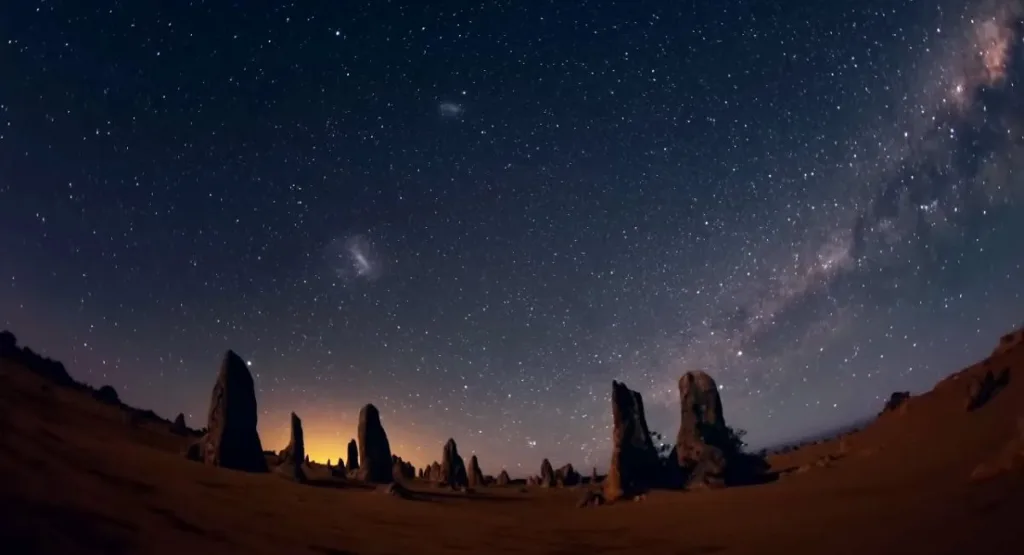
Regional WA: Several towns promote astrotourism including Gingin, Wagin, and York. The Pinnacles Desert offers unique foreground for photography. The Coral Coast and remote outback locations provide extremely dark skies.
South Australia
Adelaide Metro Area: The Adelaide Hills immediately east of the city provide darker viewing. The Fleurieu Peninsula’s beaches and McLaren Vale wine region offer good southern options.
Regional SA: The Flinders Ranges are renowned for exceptional dark skies. Kangaroo Island offers island viewing with minimal light pollution. The Eyre Peninsula also provides remote dark sky locations.
Tasmania
Statewide: Tasmania’s advantage is darkness, even locations relatively close to Hobart and Launceston offer darker skies than most mainland cities. Mount Wellington (kunanyi) provides elevated viewing over Hobart. The East Coast’s beaches at Freycinet and Bay of Fires are stunning. Cradle Mountain in the north offers mountain viewing.
Bonus: Tasmania has the best chance for Aurora Australis the same weekend. If solar activity cooperates, you might see both meteors and aurora together—an incredibly rare experience.
Northern Territory
Darwin Area: Casuarina Beach and Mindil Beach offer coastal viewing. Litchfield National Park is only 90 minutes south with darker skies.
Central Australia: The Uluru-Kata Tjuta region, Alice Springs Telegraph Station, and West MacDonnell Ranges all provide exceptional outback dark sky viewing under some of Australia’s clearest, driest air.
Australian Capital Territory
Canberra Area: Namadgi National Park south of Canberra offers dark mountain viewing. Mount Ainslie and Black Mountain provide elevated viewing within the city. The Lake George area east toward the coast has darker rural skies.
What Makes Geminids Different
The science behind the Geminids explains why they’re so impressive. Most meteor showers come from comets, icy bodies that leave trails of lightweight dust. The Geminids come from 3200 Phaethon, a 5-kilometer-wide asteroid.
Why Rocky Debris Creates Better Meteors: Phaethon’s debris particles are much denser than typical cometary dust, about 2-3 grams per cubic centimeter compared to just 0.3 g/cc for comet dust. This higher density means Geminid particles penetrate deeper into Earth’s atmosphere before burning up, creating brighter, longer-lasting meteors.
The Rainbow Effect: Geminid meteors flash multiple colors as they burn. The colors come from different metallic elements vaporizing at different temperatures:
- Yellow flashes = sodium burning
- Green/blue-green = magnesium
- Blue = calcium
- Red/violet = atmospheric nitrogen and oxygen
Speed and Trails: Geminids travel at about 35 kilometers per second, moderate speed compared to some showers. This moderate speed combined with their density means they often leave persistent glowing trails (ionization trails) that can linger for several seconds after the meteor passes.
Historical Growth: When first observed in 1862, the Geminids produced only 10-20 meteors per hour. The shower has intensified dramatically, now producing 120-150 meteors per hour under ideal conditions. Scientists believe this growth means Phaethon continues shedding material, or Earth’s orbit has moved deeper into the debris stream. Some astronomers predict the shower will keep strengthening in coming decades.
How to Watch: Complete Viewing Guide
Meteor watching doesn’t require any special equipment, in fact, telescopes and binoculars actually make it harder by limiting your field of view. Here’s everything you need to know:
Before You Go
Check the Weather: Clear skies are essential. Check the Bureau of Meteorology forecast for your chosen location. Northern Australia has summer storm risk, so have a backup location ready.
Plan Your Timing: Arrive at least 30-60 minutes before you plan to start watching. This gives you time to set up comfortably and let your eyes adjust to darkness, which takes 20-30 minutes.
Dress Appropriately: Even in December, Australian pre-dawn hours can be surprisingly cool, especially at elevation or in southern states. Dress in layers you can adjust. Bring a sleeping bag or blanket even if it seems warm when you leave home.
What to Bring
Comfort Items:
- Reclining lawn chair or thick blanket to lie on
- Pillow for neck support
- Extra blankets or sleeping bag
- Ground pad or yoga mat for cushioning
Practical Gear:
- Red flashlight (preserves night vision better than white light)
- Thermos with hot coffee, tea, or chocolate
- Snacks and water
- Bug spray (mosquitoes love stargazers)
- Portable phone charger
Optional:
- Star chart or astronomy app like PhotoPills, SkySafari, or Star Walk
- Camera equipment if attempting photography
- Bluetooth speaker for quiet music (keep volume low to not disturb others)
Viewing Technique
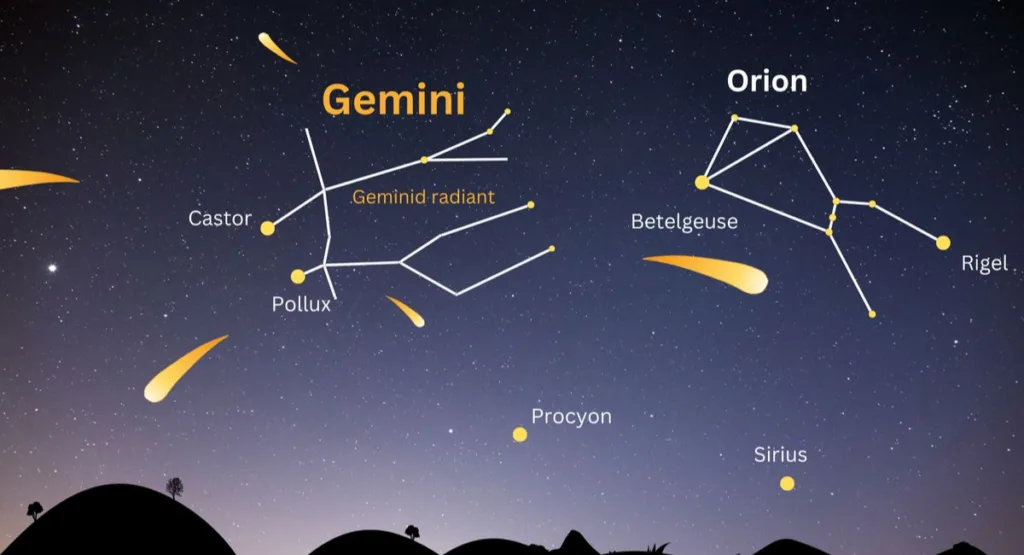
Don’t Stare at Gemini: This is the most common mistake. While meteors radiate from the constellation Gemini, they appear across the entire sky. Staring at the radiant actually means you’ll miss most meteors.
Best Position: Lie flat on your back and look straight up, or recline at about 45 degrees. Try to take in as much sky as possible with your peripheral vision. Face roughly north to north-east if you need to choose a direction.
Finding the Radiant: Jupiter will be your guide star this year. The bright planet sits near the Geminid radiant alongside Castor and Pollux (Gemini’s twin stars). Use a stargazing app to locate them in the north-eastern sky. Even from light-polluted areas, Jupiter is unmistakable as one of the brightest objects visible.
Be Patient: Meteors don’t arrive like clockwork. You might see three in rapid succession, then wait five minutes for the next one. This is normal. During peak hours under dark skies, expect an average of one meteor every 30-60 seconds, but they come in waves and lulls.
Watch with Others: Two people facing different directions will spot more meteors than one person alone. Make it social, call out when you see one, and make wishes together on shooting stars.
Avoid Phone Screens: Looking at your bright phone screen destroys your night vision for 10-15 minutes. If you must check your phone, use the red flashlight or enable your phone’s red screen mode.
What You’ll Actually Experience
Geminid meteors appear as fast-moving bright streaks. Most last a fraction of a second to about one second. The brightest ones (called fireballs) can light up the entire landscape and may last several seconds, sometimes leaving glowing trails that persist after the meteor is gone.
You’ll see different colors, yellow is most common, but watch for green, blue, and red flashes. Some meteors appear as brief points of light, while others create long streaks across half the sky.
Not every meteor you see is a Geminid. Random sporadic meteors from other debris occur all the time. To identify a true Geminid, trace its path backward in your mind, if the line points toward the Gemini/Jupiter area, it’s a Geminid. If it points elsewhere, it’s a sporadic meteor.
Capturing the Geminids: Photography Guide
Meteor photography is challenging but rewarding. You don’t need expensive gear, but you do need a camera with manual controls.
Essential Equipment
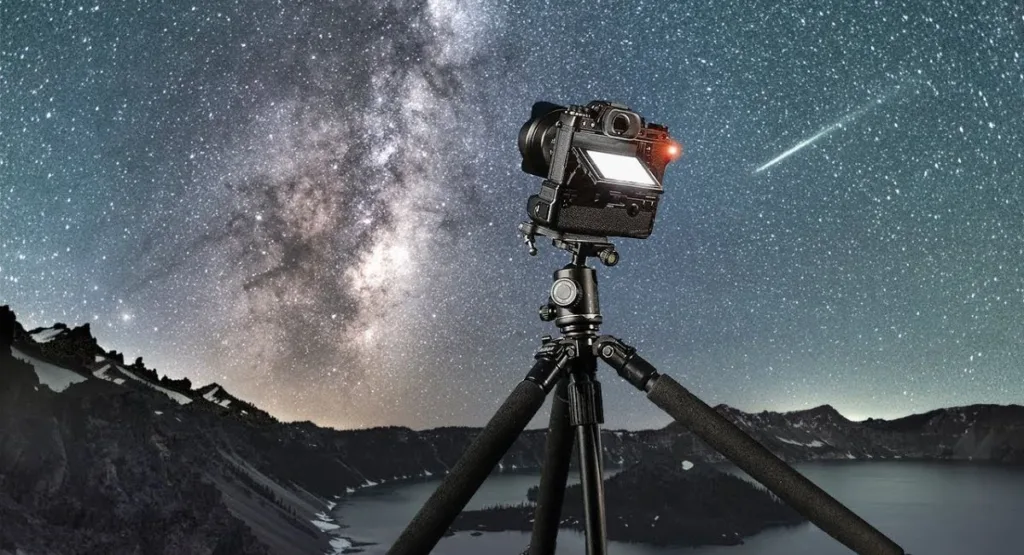
Camera: Any DSLR or mirrorless camera with manual mode works. Even high-end smartphones with manual camera apps can catch the brightest meteors.
Lens: Wide-angle is essential. A 14-24mm lens is ideal, though anything up to 35mm can work. You want the widest field of view possible. Aperture of f/2.8 or wider (f/2.0, f/1.8, f/1.4) lets in more light.
Support: A sturdy tripod is absolutely essential. Any camera movement during long exposures ruins the shot.
Remote Release: Either a cable release or wireless remote trigger prevents camera shake when pressing the shutter. Alternatively, use the camera’s self-timer set to 2 seconds.
Power: Bring multiple fully charged batteries. Cold temperatures drain them faster than normal.
Camera Settings
Start with these settings and adjust based on results:
Mode: Full manual (M mode) ISO: 1600-3200 (start at 1600, increase if meteors appear too dim) Aperture: f/2.8 or wider (use the lowest f-number your lens allows) Shutter Speed: 15-25 seconds (longer than 25 seconds causes star trailing) Focus: Manual focus set to infinity (use live view to focus on a bright star until it’s a sharp point) File Format: RAW (gives you maximum editing flexibility) White Balance: 3200-4000K (adjust later in editing)
Shooting Strategy
Composition: Include interesting foreground elements, trees, landscapes, buildings not just blank sky. Use the rule of thirds. Don’t center the horizon.
Continuous Shooting: Use an intervalometer (most cameras have this built in) to take photos continuously throughout the night. Set it to shoot one photo every 16-27 seconds (depending on your shutter speed). You’ll take hundreds of photos, and a few will have meteors.
Point Your Camera: Aim away from the radiant rather than at it. Meteors farther from Gemini appear longer and more dramatic. Face north-east but don’t point directly at Gemini.
Be Realistic: You might photograph for 2-4 hours and only catch 5-10 meteors. That’s normal. The more hours you shoot, the better your chances.
Post-Processing
In editing software like Lightroom or Photoshop:
- Adjust exposure and contrast
- Reduce noise in dark areas (but don’t overdo it)
- Enhance meteor trails selectively
- Stack multiple images with meteors using software like Starry Landscape Stacker
Most Important: Don’t spend the entire night staring at your camera screen. Actually watch the show with your eyes. The experience matters more than the perfect shot.
City Viewing: Is It Worth It?
Absolutely. While rural dark skies let you see every meteor including the faint ones, bright Geminids punch through light pollution surprisingly well. From suburban areas of major cities, you’ll see 30-50% of dark sky rates. Even from inner city locations, the brightest meteors remain visible.
Urban Viewing Tips:
- Find a park or open space away from direct streetlights
- Position yourself so buildings block nearby lights
- Look toward the darkest section of visible sky
- Your eyes will adjust better than you expect
- Even 10-15 kilometers from a city center significantly improves viewing
Major Australian cities all have accessible viewing spots within 30-60 minutes’ drive that offer dramatically darker skies than the urban core.
Special Viewing Events
Perth Observatory hosts special Geminids viewing nights with telescopes set up on other celestial objects, hot drinks, and volunteer astronomers to answer questions. Bookings required, check their website.
Thredbo, NSW offers a unique experience: a guided 13-kilometer night hike to the summit of Mount Kosciuszko (Australia’s highest peak) specifically for meteor viewing. This Grade 3 round-trip hike puts you above much of the atmosphere in pristine dark skies.
Astronomy Clubs in most states organize group viewing events. Check with:
- Astronomical Society of NSW
- Astronomical Society of Victoria
- Queensland Astronomical Society
- Astronomical Society of South Australia
- Astronomical Society of Western Australia
Group events are excellent for beginners—experienced members help identify meteors and answer questions.
Contributing to Science: Report What You See
You can become a citizen scientist by reporting meteor observations, especially bright fireballs.
Fireballs in the Sky: Curtin University operates a network tracking meteors across Australia. If you see an exceptionally bright meteor (brighter than Venus), report it at fireballs.ndc.nasa.gov. Your report helps scientists track potential meteorite falls.
International Meteor Organization: Submit detailed observation reports at imo.net. Scientists use these reports to understand meteor shower behavior, predict future activity, and study how showers change over time.
Bonus Sky Events This December
While watching for meteors, you’ll see other celestial highlights:
Jupiter reaches opposition in early December, meaning it’s at its brightest and most prominent for the year. It sits near the Geminid radiant, making it an easy guide star. Through binoculars, you can see Jupiter’s four largest moons.
Mars increases in brightness through December with its distinctive reddish-yellow glow. It rises in the east several hours after sunset.
The Milky Way stretches across the southern sky from dark locations, providing a stunning backdrop for meteor watching.
Southern Cross and other southern constellations are well-placed for viewing.
Aurora Australis: Tasmania and southern Victoria have chances for southern lights if solar activity cooperates. The same weekend as the Geminids peak coincides with potential aurora activity—imagine seeing both meteors and aurora together!
Stay informed about all upcoming celestial events, from meteor showers to rare astronomical phenomena, through our comprehensive stargazing guides.
Frequently Asked Questions
Q: Do I need a telescope or binoculars?
Ans: No, they actually make meteor watching harder by limiting your field of view to a tiny patch of sky. Meteor showers are best viewed with naked eyes so you can see the entire sky at once.
Q: What if I fall asleep while watching?
Ans: Totally normal! Meteors come in waves with quiet periods in between. Many people doze off during long viewing sessions. Just make sure you’re comfortable and safe if you plan to sleep outside.
Q: Can young children enjoy meteor showers?
Ans: Definitely. The Geminids are particularly family-friendly because activity starts around 9-10 PM—early enough for kids. Even young children enjoy spotting “shooting stars” and making wishes. Bring their favorite blanket and make it a special late-night adventure.
Q: Is it safe to lie outside in the dark?
Ans: Choose safe locations away from roads, cliffs, and water. Let someone know where you’ll be. In warmer areas, watch for snakes and use a ground mat or blanket. Check for ticks afterward if in bushland.
Q: Will meteors make noise?
Ans: Almost always silent. Very rarely, extremely bright fireballs produce sonic booms that arrive several seconds after the visual flash. Most viewers never hear one.
Q: Can I see both Geminids and Aurora Australis together?
Ans: Yes! Tasmania and southern Victoria have the best chances. If solar activity cooperates the same weekend as the Geminids peak, you might witness this rare double phenomenon—meteors streaking across the sky with aurora dancing on the southern horizon.
Q: How do I tell a Geminid from a random meteor?
Ans: Trace the meteor’s path backward in your mind. If the line points toward Gemini (near Jupiter), it’s likely a Geminid. If it points elsewhere, it’s a sporadic meteor. Both are cool to see!
Q: What’s the difference between a meteor, meteoroid, and meteorite?
- Meteoroid: The actual rock/debris floating in space before it enters Earth’s atmosphere
- Meteor: The bright streak (shooting star) you see as it burns up in the atmosphere
- Meteorite: Any fragment that survives and reaches the ground (extremely rare for shower meteors, which burn up completely)
Q: Geminids or Perseids which shower is better?
Ans: The Geminids typically win. They produce higher hourly rates (120 vs 90 per hour), have brighter meteors on average, show more colorful displays, and are more reliable year-to-year. The Perseids are famous mainly because they occur in August when northern hemisphere weather is warm—but for pure meteor performance, the Geminids are superior.
Weather Considerations and Backup Plans
Northern Australia (Queensland, Northern Territory): Summer brings afternoon storms and humidity. Check forecasts carefully. Inland locations often have clearer skies than coastal areas. Have a backup location ready.
Southern Australia (Victoria, Tasmania, South Australia): Generally clear conditions but cooler temperatures. Bring extra layers. Check for overnight low temperatures at your viewing location.
NSW and ACT: Variable conditions. Mountain areas can be significantly cooler than Sydney. Check forecasts for both cloud cover and temperature.
Western Australia: Usually excellent conditions, especially inland. Coastal areas may have sea fog in early mornings.
If Your Peak Night is Cloudy: The Geminids remain active December 12-16 with strong rates. Try the night before (December 12-13) or the night after (December 14-15) the peak. Even December 11-12 or 15-16 can produce 40-60% of peak rates—still impressive.
The Science: Understanding Asteroid 3200 Phaethon
Phaethon remains somewhat mysterious to scientists. Discovered October 11, 1983 by NASA’s Infrared Astronomical Satellite (IRAS), it was the first asteroid discovered by a spacecraft. It’s named after the Greek mythological figure who drove the sun-god Helios’ chariot too close to the sun.
Orbital Characteristics:
- Diameter: 5.1 kilometers (about 3.2 miles)
- Orbital period: 1.4 years
- Closest approach to the Sun: Just 0.14 AU—closer than Mercury’s orbit
- Highly elliptical orbit
The “Rock Comet” Puzzle: Phaethon doesn’t develop a visible tail when it approaches the sun, and its spectrum matches rocky asteroids rather than icy comets. Yet its comet-like orbit and the fact it produces a meteor shower puzzle scientists. Current theory suggests Phaethon might be a “dead comet” that lost its ice long ago, or a “rock comet” where extreme solar heating causes thermal fracturing that releases rocky particles—potentially a new category of object.
Why the Shower Keeps Growing: Historical records show dramatic intensification since the 1800s. Either Phaethon continues actively shedding debris with each solar pass, or Earth’s orbit has slowly moved deeper into the existing debris stream. Some astronomers predict the Geminids will continue strengthening over coming decades, potentially becoming even more impressive.
Your 24-Hour Countdown
Day Before (December 13):
- Check weather forecast for your chosen location and backup location
- Charge all camera batteries and devices
- Pack your viewing supplies (blankets, snacks, red flashlight)
- Download offline star charts in case of no signal
- Note exact moonset time for your location
- Set multiple alarms for 1:30-2:00 AM
Peak Night (December 13-14):
- Eat a light dinner (heavy meals make you sleepy)
- Dress in warm layers before leaving
- Arrive at your location by midnight or earlier to claim a good spot
- Set up your comfort zone—chair, blankets, refreshments
- Turn off all lights and electronic devices
- Allow 20-30 minutes for your eyes to fully adjust to darkness
- Relax, look up, and be patient—meteors come in waves
Alternative Viewing Nights:
- December 12-13 (night before peak): 80-90% of peak rates
- December 14-15 (night after peak): 70-80% of peak rates
- December 11-12 or 15-16: 40-60% of peak rates—still worthwhile
Final Thoughts
The 2024 Geminids offer exceptional viewing conditions throughout Australia. With minimal moon interference, bright colorful meteors, and generally favorable summer weather, this December weekend promises an unforgettable celestial experience.
Whether you’re an experienced stargazer or planning your first meteor shower viewing, the Geminids deliver. The debris from asteroid 3200 Phaethon has traveled for 1.4 years through space to create this display, and all that’s required from you is a dark location, comfortable setup, and patience.
As the final major meteor shower of 2024, the Geminids provide the perfect opportunity to close out the year under the stars. From Darwin’s tropical nights to Tasmania’s southern shores, from Perth’s western coast to Brisbane’s eastern skies, every corner of Australia can witness this cosmic display.
Find your dark sky location, mark your calendar, set your alarm, and prepare for nature’s December finale. The universe is putting on a show, and you have a front-row seat.
Clear skies, Australia!