C1 results are often the first thing football fans search for after every Champions League match night. From the opening group-stage kick-off in September to the final whistle of the final in late May, the demand for fast, accurate, and detailed data never slows down. A single, convenient platform that gathers every piece of Champions League information in one place solves that problem completely.
All Champions League data in one convenient platform
The UEFA Champions League spans nearly nine months each season and includes more than 125 official matches across multiple stages. Following standings, fixtures, results, and news across that period becomes inefficient without a unified data system. A specialized Champions League platform consolidates every key dataset into one streamlined interface.
Users can access updated group standings after each matchday, real-time knockout brackets, and match results delivered within 0.3 seconds of confirmation. Kick-off times automatically adjust to Vietnam’s time zone, eliminating manual conversions for European fixtures. This creates a smoother experience during busy midweek match schedules.
Beyond basic scores, each match page presents lineups, substitutions, goal timelines, cards, and in-game events. Data from group stages, round of 16, quarter-finals, semi-finals, and finals remains archived for long-term reference. Fans can easily revisit historic clashes or compare performances across seasons.
Match results and fixture schedules
Before exploring deeper analytics, users are introduced to a structured overview of fixtures and results. This helps identify how each match fits into the Champions League timeline.
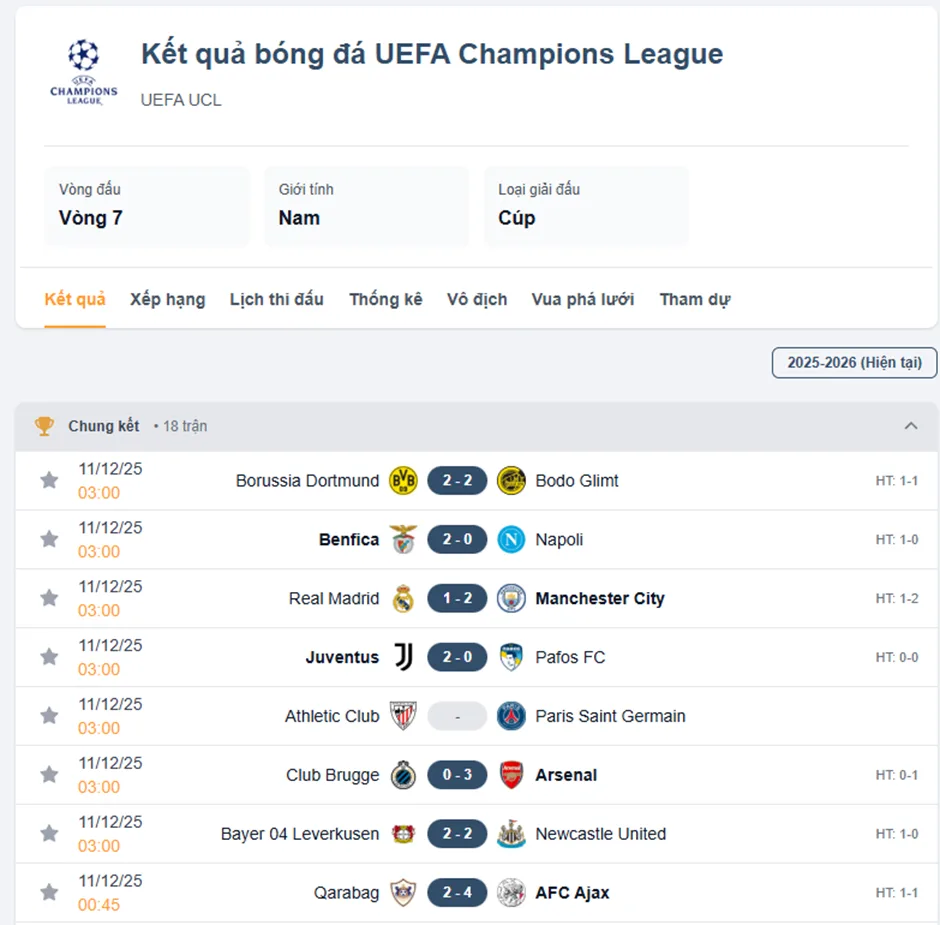
All Champions League data in one convenient platform
Fixture lists display exact dates, kick-off times, venues, and competing clubs. Result updates include final scores, halftime scores, goal scorers, and disciplinary records. Historical results dating back to 2006 allow comparisons between legendary teams, finals, and record-breaking campaigns.
Live standings and knockout progression
Group-stage standings update immediately after matches conclude. Rankings reflect official UEFA tie-breaking rules, including goal difference and head-to-head performance.
Knockout brackets visualize progression from the round of 16 to the final. Users can track each team’s path, previous opponents, and potential matchups without navigating away from the competition overview.
News and contextual Champions League updates
Match data gains depth when paired with relevant context. News coverage highlights injuries, suspensions, squad rotations, and tactical decisions ahead of each matchday.
Additional updates include transfer developments, managerial strategies, and form analysis. This ensures users understand not only match outcomes, but also the underlying factors influencing results.
Does the platform ensure complete and accurate information?
Speed and accuracy determine the credibility of football data platforms. Champions League matches often feature decisive moments within seconds, making delayed or inconsistent data unacceptable. Advanced technology layers ensure reliability at every stage of data delivery.
Before examining specific technologies, a brief overview explains how live match data flows through automated systems. Information is collected, verified, and distributed in real time, minimizing manual errors.
Real-time processing with ultra-low latency
The platform operates with a latency of just 0.3 seconds, faster than many live television broadcasts. Goals, red cards, substitutions, and VAR decisions appear almost instantly after validation.
This speed proves critical on Champions League nights with multiple simultaneous fixtures. Fans can follow several matches live without refreshing pages or switching platforms.

The platform operates with a latency of just 0.3 seconds
Big data analytics and large-scale processing
Each Champions League season generates millions of data points. Every pass, shot, duel, sprint, and positional change contributes to a continuously expanding dataset.
Big data analytics convert raw events into structured insights. Users can compare team performances across different stages, opponents, and venues with clarity and consistency.
AI and machine learning cross-verification
Artificial intelligence systems automatically cross-check data from multiple trusted sources. Machine learning algorithms detect anomalies, validate sequences, and correct inconsistencies in real time.
This automated verification supports an accuracy rate of 99.8%. Such precision strengthens confidence for fans analyzing trends or reviewing historical Champions League performances.
Expected goals (xG) and advanced match models
Expected goals metrics evaluate chance quality rather than shot volume. A dedicated xG model provides match-level insights into attacking efficiency and defensive resilience.
Each Champions League match includes xG values for both teams, helping users assess whether results aligned with performance. This adds analytical depth beyond the final score.
Visual analytics with heat maps and pass maps
Visual tools simplify complex data interpretation. Heat maps illustrate player movement, average positioning, and activity zones throughout matches.
Pass maps highlight passing networks and buildup patterns. These visuals reveal tactical structures used by elite Champions League teams, from possession-based systems to counter-attacking approaches.

Visual tools simplify complex data interpretation
Important notes when following Champions League data
Even with a comprehensive platform, understanding how to interpret football data remains important. A short introduction prepares users to read Champions League information effectively and responsibly.
The following points outline key considerations while reinforcing platform reliability and multi-competition coverage.
- Match data updates instantly, though VAR reviews may cause brief confirmation delays.
- Group standings follow official UEFA tie-breaking criteria at all times.
- Advanced metrics such as xG or progressive passes provide insight when combined with match context.
- Historical data supports long-term analysis across seasons, managers, and tactical trends.
- The same system also covers more than 1,000 global competitions beyond the Champions League.
- All features remain free to access, supporting both casual fans and dedicated analysts.
Conclusion
All Champions League data in one convenient platform reshapes how fans engage with Europe’s premier competition. Fast updates, advanced analytics, and clear presentation remove uncertainty from match tracking. From C1 results to tactical insights, every detail stays accessible throughout the season. This creates a complete, reliable, and engaging Champions League experience for modern football audiences.